
Solar Panel Direction Perth: Which Way Should Your Roof Panels Face?
A data-led guide for WA homeowners comparing north, east, west and split arrays, plus tilt, shading, batteries and the DEBS 3pm to 9pm export window.
Get a Free Roof LayoutRead the FAQs
Short answer: the best solar panel direction Perth homes can choose for total yearly output is north. In our model of a 6.6kW system in Perth, north-facing panels produced about 11,047kWh a year, while east produced about 89% of that and west about 87%. West-facing panels are still worth it when you use a lot of power after 3pm or want more energy in the DEBS peak export window, and an east-west split suits roofs without a good north face. A battery narrows the gap, because it stores midday energy for the evening.
Why Solar Panel Direction Matters in Perth
Panel orientation (also called azimuth) is the compass direction a roof face points. Perth sits at about 32 degrees south, and the Bureau of Meteorology lists the Perth Airport weather station at latitude 31.93 degrees S. For an unshaded Perth roof, north-facing panels generally produce the most electricity over a full year.
Perth is a strong place for rooftop solar. According to the Bureau of Meteorology climate statistics for Perth Airport, the city averages 8.8 hours of sunshine per day across the year and about 138.7 clear days annually. January averages 11.6 sunshine hours a day, while June drops to 6.0 hours. That seasonal swing is exactly why panel direction and tilt change your winter output so much.
The Australian Government's YourHome guide to photovoltaic systems gives the same general rule: in the southern hemisphere, face modules north towards the equator for the most energy over a year, and consider north-east, east, north-west or west faces when your demand peaks in the morning or afternoon.
Solar Panel Direction Perth Data: Output by Roof Face
To put real numbers on solar panel direction in Perth, we ran the European Commission Joint Research Centre PVGIS model (ERA5 solar data, 2005 to 2023) for a 6.6kW system in central Perth with a 20 degree roof pitch and 14% system losses. These are model estimates, not guarantees, but they show the relative difference between roof faces clearly.
| Roof direction | Est. annual output (kWh) | Average per day (kWh) | Share of north output |
|---|---|---|---|
| North | 11,047 | 30.3 | 100% |
| North-east | 10,751 | 29.5 | 97% |
| North-west | 10,632 | 29.1 | 96% |
| East | 9,817 | 26.9 | 89% |
| West | 9,647 | 26.4 | 87% |
| South-east | 8,618 | 23.6 | 78% |
| South-west | 8,492 | 23.3 | 77% |
| South | 7,965 | 21.8 | 72% |
Model estimate: PVGIS (European Commission JRC), 6.6kW, 20° tilt, 14% losses, latitude 31.95 S, longitude 115.86 E. Real output depends on shading, panel brand, inverter and dust.
Three takeaways stand out. North-east and north-west faces lose only about 3 to 4% against true north, so a slightly skewed roof is not a problem. East and west faces still deliver close to nine tenths of north output. South faces lose more than a quarter of yearly energy and are usually a last resort.
Winter is where direction really shows
The same model shows a big seasonal gap. In June, north panels produced about 593kWh, east about 398kWh, west about 390kWh and south only about 168kWh. In December the four directions finished within roughly 4% of each other, because the summer sun sits high overhead. If winter bills worry you, prioritise north.
East, West and Split Arrays
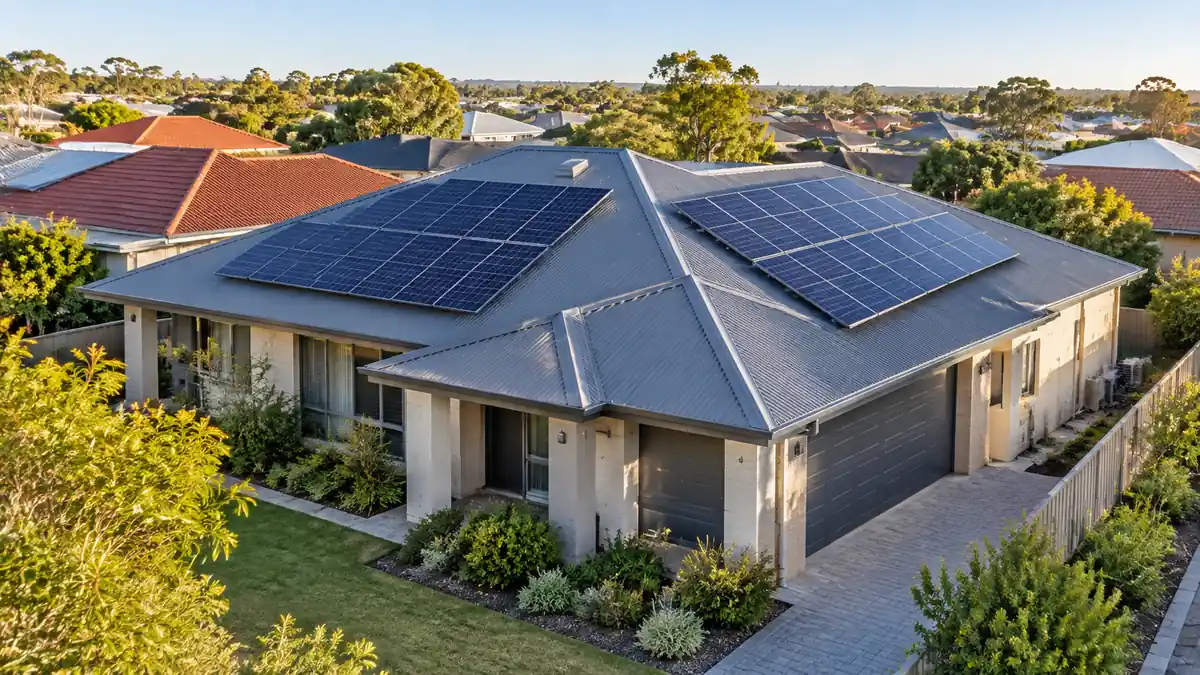
Plenty of Perth homes have a hip roof whose best faces point east and west. That is not a deal breaker. An east-west split system places panels on both faces so generation starts earlier and finishes later, giving a flatter daily curve than a north array.
West-facing panels for late afternoon generation
Western Australia rewards later generation. According to Energy Policy WA, the Distributed Energy Buyback Scheme (DEBS) aims to get households using or storing midday solar, and it openly favours west facing arrays that keep generating into the late afternoon. For Synergy customers, the page lists 10 cents per kWh for exports between 3pm and 9pm, and 2 cents per kWh between 9pm and 3pm.
Our hourly model for 2020 shows why west matters here. About 25.8% of a west array's output arrived after 3pm, compared with 14.7% for north and 7.0% for east.
West-facing panels can generate more in the late afternoon than north-facing panels. A battery can store surplus solar for use after sunset. For eligible Synergy DEBS customers, the peak export rate applies from 3 pm to 9 pm.
East-facing panels for early risers
East faces suit households that run pool pumps, dishwashers or air conditioning in the morning. In the same model, 47.1% of east output landed before 11am. Under the Synergy Midday Saver plan, the cheapest band runs from 9am to 3pm, a window first trialled by the WA Government in 2020. Our Synergy Midday Saver guide for Perth households explains how to match appliance timing to that band.
| Orientation (20° tilt) | Model annual output (kWh, 2020) | Output after 3pm (kWh) | Share after 3pm | Share before 11am |
|---|---|---|---|---|
| North | 10,921 | 1,610 | 14.7% | 33.6% |
| West | 9,556 | 2,461 | 25.8% | 20.8% |
| East | 9,743 | 677 | 7.0% | 47.1% |
Model estimate: PVGIS hourly series for 2020, 6.6kW, times converted to Perth time (AWST).
In plain terms, west panels give up about 13% of yearly energy but deliver roughly 850kWh more after 3pm than north panels. Whether that trade pays off depends on your evening usage and export limits.
The Best Tilt Angle for Perth Roofs
Tilt angle is how steeply a panel leans up from flat. YourHome suggests a tilt within 10 degrees of your latitude to maximise yearly energy, which points to roughly 22 to 42 degrees in Perth. Most Perth roofs are pitched at 20 to 25 degrees, which already sits close to the sweet spot.
| Tilt (north-facing) | Est. annual output (kWh) | Share of best tilt |
|---|---|---|
| 0° (flat) | 10,008 | 90% |
| 10° | 10,658 | 95% |
| 20° | 11,047 | 99% |
| 30° (model optimum) | 11,168 | 100% |
| 40° | 11,015 | 99% |
Model estimate: PVGIS (European Commission JRC), 6.6kW, north-facing, 14% losses.
In our Perth model, a north-facing array at a 30° tilt produced the highest annual output, yet a standard 20 degree pitch still reached about 99% of that yield. Tilt frames on a flush roof rarely pay for themselves, while flat installs lose around 10% and also collect more dust.
Shading and Roof Types
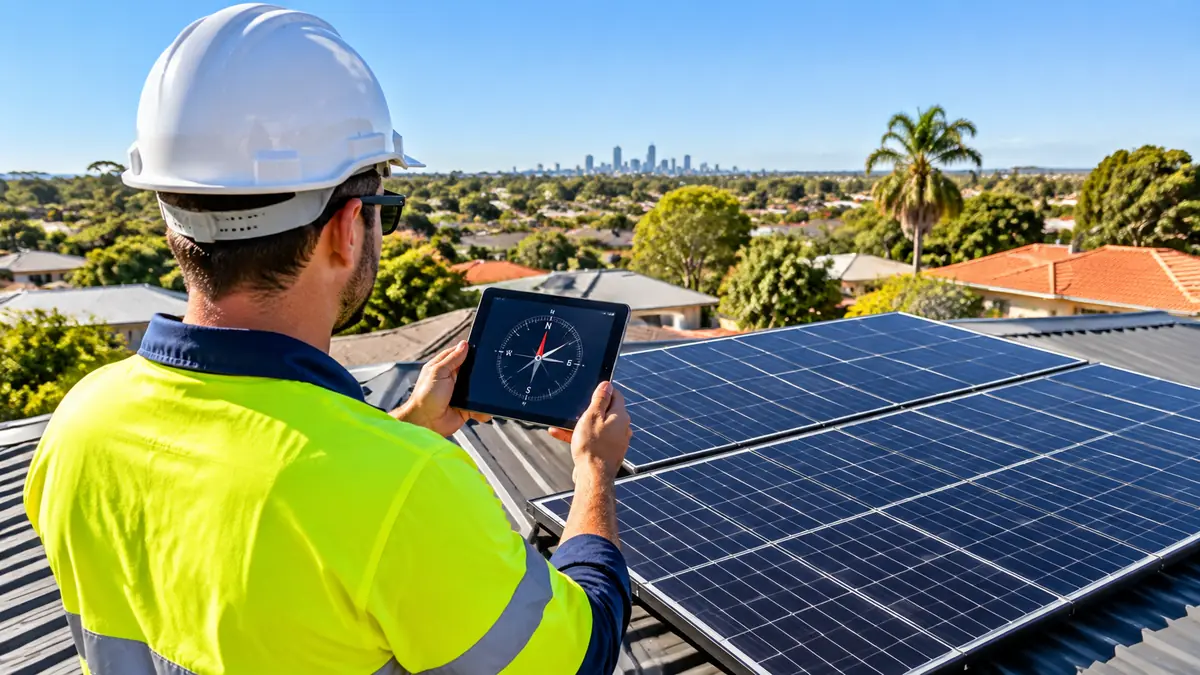
Choosing the right solar panel direction in Perth only helps if the sun can reach the panels. The South Australian Government's solar PV guidance says panels produce more power when they face full sun between 9am and 3pm, warns against shade from objects such as antennas, and suggests facing panels north or spreading them over east and west areas.
Common shading culprits in Perth suburbs
Watch for neighbouring two-storey homes, tall eucalypts, chimneys, air conditioner units and TV antennas. A shaded north face can produce less than a clear west face, so a site check matters more than a compass alone. Microinverters or optimisers can limit the damage when shade is unavoidable; our solar inverter installation service can help you weigh up those options.
Tile versus Colorbond
Terracotta and concrete tile roofs use hooks under the tiles, while Colorbond and other metal roofs use clamps or brackets fixed through the sheet. Both handle north, east or west layouts well. Metal roofs often allow longer unbroken rows, which helps on split arrays.
Batteries Change the Direction Debate
A home battery stores surplus midday solar and releases it after sunset, so the timing of generation matters less. With storage, panel direction becomes less critical, and many Perth households can chase total yield with north panels and still cover the 3pm to 9pm period from the battery. Energy Policy WA notes that DEBS pays for exports from rooftop solar, batteries and electric vehicles, with no cap on battery size, although retailers only have to pay for the first 50kWh exported per day per premises.
If you are adding storage, browse our solar battery range for Perth homes. If you are still sizing panels, the 6.6kW solar panel system page is a useful starting point, and for exports see our solar feed-in tariff guide for Perth and WA.
Solar Panel Direction Perth Checklist
- Check which roof faces point north, east and west with a compass app.
- Note shade from trees, chimneys and neighbours at 9am, noon and 3pm.
- Look at your bill or smart meter data to see when you use the most power.
- Decide whether you want maximum yearly output or more evening energy.
- Consider an east-west split if your north face is small or shaded.
- Factor in a battery if your evening usage is high.
- Use an installer accredited by Solar Accreditation Australia (SAA) who models your actual roof.
The team at Fusion Sun Solar designs residential solar systems across Perth around each roof's real orientation, pitch and shading rather than a one size layout.
Solar Panel Direction Perth: Your Questions Answered
What is the best solar panel direction in Perth?
North is best for total yearly energy. In our PVGIS model, north panels produced about 11,047kWh a year from a 6.6kW system, more than any other roof face.
Are west-facing solar panels worth it in Perth?
Yes, for many homes. West panels produced about 87% of north output in our model but delivered 25.8% of their energy after 3pm. West-facing panels can generate more in the late afternoon than north-facing panels. A battery can store surplus solar for use after sunset. For eligible Synergy DEBS customers, the peak export rate applies from 3 pm to 9 pm.
Is east or west better in Perth?
They are close. East produced slightly more energy across the year in our model, while west produced far more after 3pm. Pick east for morning use and west for late afternoon use.
Can solar panels face south in Perth?
They can, but a south face produced only about 72% of north output in our model and dropped to about 168kWh in June. Use south only when other faces are full or shaded.
What tilt angle is best for solar panels in Perth?
In our Perth model, a north-facing array at a 30° tilt produced the highest annual output. At 20°, it still produced about 99% of that yield, so most Perth homes mount panels flush with the roof.
Does a battery mean panel direction matters less?
Largely, yes. A battery shifts midday solar into the evening, so north panels plus storage can cover peak hours while still producing the most energy overall.
Conclusion
For most homes, the best solar panel direction Perth offers is north, with north-east and north-west close behind. East and west faces still deliver strong yields, and west panels line up neatly with WA's 3pm to 9pm peak export window. Split arrays, sensible tilt, clear shade lines and a battery can turn almost any Perth roof into a productive solar roof.
Get a Roof Layout Designed for Your Home
Talk to Fusion Sun Solar about the best panel direction, tilt and battery mix for your Perth roof.
Book a Free Solar AssessmentSources
- Bureau of Meteorology, Climate statistics for Perth Airport (009021)
- Energy Policy WA, Energy Buyback Schemes (DEBS)
- WA Government media statement, Midday Saver pilot (December 2020)
- Australian Government YourHome, Photovoltaic systems
- SA.GOV.AU, Solar photovoltaic systems and battery storage
- Clean Energy Regulator, Solar Accreditation Australia announced as new accreditation scheme operator
- European Commission Joint Research Centre, PVGIS 5.3 (ERA5 database), model runs for latitude 31.95 S, longitude 115.86 E, November 2026