
Perth solar panel rebates: what changes on 1 January 2027 and why timing still matters
Comparing a December installation with a January booking? The solar rebate WA 2027 calculation changes on 1 January, when eligible household rooftop solar moves from five deeming years to four. For Perth households, the useful question is what that difference means on the quote, not whether to rush.
Discuss your solar plans
- The installation year determines the rooftop PV deeming period.
- A deposit does not lock in an earlier year's certificate entitlement.
- Certificate prices, eligibility and the complete installed quote still matter.
Solar rebate WA 2027: what changes on 1 January?
For eligible small-scale rooftop solar PV (up to 100 kW), the maximum deeming period falls from five years for a 2026 installation to four years for a 2027 installation. Solar support continues after January.
For eligible household solar, the federal support discussed here comes through the Small-scale Renewable Energy Scheme (SRES), which the Australian Government provides. For rooftop PV, a small-scale technology certificate (STC) is a tradable certificate based on estimated eligible generation. The Clean Energy Regulator (CER) administers the scheme.
What people call the solar rebate WA 2027 figure is usually an STC-based discount that installers include in quotes. Most owners receive the discount upfront by giving a registered agent the right to create those certificates. It is not an automatic cash payment to every household.
| Installation year | Deeming years |
|---|---|
| 2026 | 5 |
| 2027 | 4 |
| 2028 | 3 |
| 2029 | 2 |
| 2030 | 1 |
A deeming period estimates future renewable generation for certificate purposes. It is not the system warranty or expected service life. The CER schedule reduces this period annually until the scheme ends in 2030.
How is the solar rebate WA 2027 estimate calculated?
For this household PV example, multiply panel capacity in kW by the postcode zone rating and the applicable deeming years, then round down to whole certificates.
The calculation uses the solar array's rated capacity, not simply the inverter label. Perth postcode 6000 falls in Zone 3 with a rating of 1.382 in the CER postcode table. Check the actual installation postcode rather than assuming all Western Australian addresses share a zone.
Certificate count: multiply the panel capacity (kW), the installation postcode's zone rating and the deeming years; discard any fraction.
Use the official small generation unit calculator to check a proposed installation. Its result is an approximate guide, not a guarantee of eligibility. Your designer must also assess the roof, shading, electrical supply and household consumption.
Keep units separate when reviewing a solar rebate WA 2027 proposal. Kilowatts (kW) describe rated power, while kilowatt-hours (kWh) describe energy over time. The example uses panel capacity, not a predicted daily generation figure. Two homes with the same certificate estimate can still have different electricity bills because shading, usage patterns and system operation differ.
Does paying a deposit secure the 2026 entitlement?
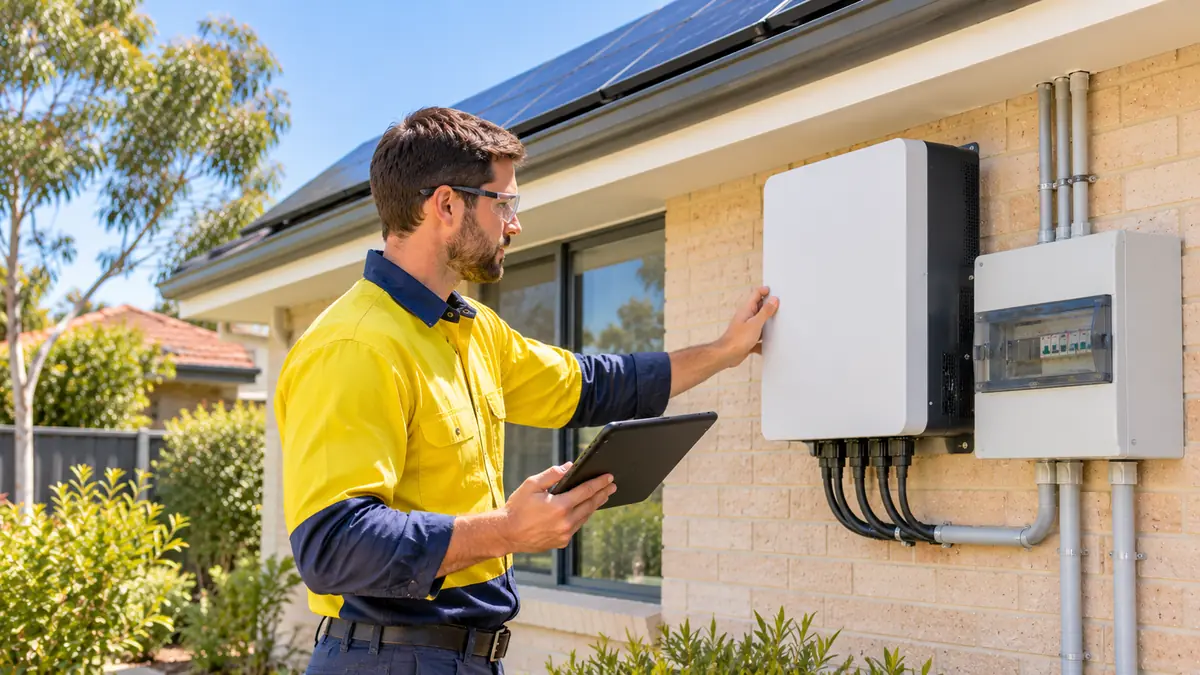
No. The installation date matters, not the date of your quote, deposit or equipment delivery. The finished installation has to be able to generate electricity and deliver it, rather than just have panels mounted.
Under the CER installation guidance, check the certificate of compliance for evidence: its recorded date for testing and commissioning shows when generation became possible. Panels sitting on a roof without completed wiring do not satisfy that requirement.
CER can classify a grid-connected installation as complete while its inverter is still awaiting connection to the meter or main grid. That does not remove Western Power's connection conditions or permission requirements.
The CER creation rules allow 12 months after installation for certificate creation. An eligible December 2026 installation can therefore have certificates created in 2027 within that window while retaining its 2026 installation-year entitlement. The window does not let an incomplete 2027 installation claim an earlier year.
What could a 6.6 kW Perth system receive?
An illustrative eligible 6.6 kW array at postcode 6000 produces an estimate of 45 STCs in 2026 or 36 STCs in 2027, using maximum deeming periods.
To isolate the solar rebate WA 2027 difference, this comparison holds the Perth postcode and array size steady. The table changes only the installation year; it is not a quotation or promised payment.
| Calculation | 2026 installation | 2027 installation |
|---|---|---|
| Formula | 6.6 x 1.382 x 5 | 6.6 x 1.382 x 4 |
| Before rounding | 45.606 | 36.4848 |
| Whole STCs | 45 | 36 |
| At $40 per STC, excluding GST | $1,800 | $1,440 |
The difference is nine certificates, or $360 using that reference price. The CER clearing house has a fixed price of $40 per certificate excluding GST, but no guaranteed sale timeframe. Open-market prices vary with supply and demand.
Your actual benefit depends on the market price passed on by the retailer, fees and contract terms. The figures above are clearing house illustrations only. They do not predict future retail prices or your final installed cost.
What must be checked before booking installation?
A solar rebate WA 2027 quote should identify equipment and certificate assumptions clearly. Check the people as well as the products: CER requires the relevant design and installation accreditation through Solar Accreditation Australia (SAA). On these grid-connected jobs, the accredited installer also needs an unrestricted WA electrical licence. The Clean Energy Council (CEC) maintains approved panels and inverter lists. CEC product approval and SAA installer accreditation are different checks.
| Check | Ask for |
|---|---|
| STCs | Estimated count, assigned rights, discount and fees |
| Equipment | Exact approved panel and inverter models |
| People | Relevant SAA accreditation and electrical licence |
| Connection | Application responsibility and site conditions |
| Timing | Installation assumptions and delay terms |
| Handover | Compliance documents and WA Notice of Completion |
Western Power's Embedded Generation Connection application is needed when installing a new inverter system, altering or moving an existing inverter, or adding generation from another source. Confirm approvals before work proceeds.
Approved-product status also needs checking against the proposed completion date. Under CER rules, installation and commissioning must both finish before the expiry shown for each listed component. Keep copies of the quote, assignment form and handover paperwork together, so the equipment and installation details can be matched to the certificate estimate.
For local technical context, read our May 2026 WA solar requirements guide. Expanding an existing array? Our Perth system upgrade guide covers the separate design and eligibility questions.
Is a solar rebate the same as a feed-in tariff?
No. STCs support an eligible installation. A feed-in payment relates to electricity exported to the grid after installation.
The WA Government's Distributed Energy Buyback Scheme (DEBS) guidance explains time-of-export payments for eligible customers. These are separate from STCs. Check current retailer eligibility and rates rather than assuming the January STC change also changes your electricity tariff.
Our Perth feed-in tariff guide covers export payments. Compare expected self-consumption and exports, not just the upfront discount.
Batteries have separate eligibility and support calculations. Keep the two battery support options distinct when reading a combined proposal: the WA Residential Battery Scheme and the federal Cheaper Home Batteries Program operate alongside each other. For that decision, use our battery rebates before 2027 guide. Do not apply this article's panel formula to battery capacity.
Should you rush to install before January?

Plan early if a compliant 2026 installation is practical, but do not sacrifice suitable equipment, safe workmanship or clear contract terms for a deadline.
For Perth households, the solar rebate WA 2027 amount is only one part of the investment. Compare the total installed cost, warranties, after-sales support and how well the array matches your daytime use. A larger certificate count cannot fix an unsuitable design.
Ask what happens if weather, roof repairs, stock availability or approval issues push completion into January. Get any revised discount and payment obligations in writing. A sales promise should not be confused with a confirmed installation date.
Put solar rebate WA 2027 offers side by side with two prices visible: the gross system price and the net amount after the STC discount. If one proposal assumes December and another assumes January, ask for both on the same installation-year basis. This makes the effect of the certificates visible without confusing it with equipment quality or extra electrical work.
Use our guide to choosing solar panels when comparing options. If January is the realistic installation window, assess the four-year entitlement honestly rather than relying on a rushed December booking.
Solar rebate WA 2027 FAQs
Will panel support still be available after the January step-down?
No. The maximum small-scale rooftop PV deeming period changes to four years. The published schedule continues through 2030, subject to eligibility and the rules applying when installed.
Is the reduction a 20% increase in system cost?
No. Five deeming years becoming four is a 20% reduction before certificate rounding, not a 20% rise in the complete system price. Equipment and installation costs are separate.
Can a December deposit preserve five deeming years?
No. A deposit does not establish the installation date. Confirm when the complete system will be capable of producing and delivering electricity and retain the compliance evidence.
Must 2026 certificates be created before New Year?
Not necessarily. There is a 12-month deadline after installation for creating them. The installation year, rather than the creation year, determines the relevant deeming period.
Is every STC worth $40 to the homeowner?
No. The $40 reference applies to clearing house trading, with GST excluded. Open-market prices and the net discount offered by a retailer can differ, and clearing house sales can involve waiting.
Can existing panels receive the rebate again?
Do not assume so. Existing panels already covered by an STC claim cannot be included in a new extension claim. Eligible new additions require assessment of the equipment, prior claims and installation rules.
Do I need a battery to receive panel STCs?
No. Eligible rooftop PV can qualify without a battery. Battery incentives have their own requirements and should be listed separately in a combined quote.
What should a solar rebate WA 2027 quote show?
Look for panel capacity, exact equipment models, estimated STCs, the certificate discount, complete installed price and timing assumptions. Ask who bears any change if installation moves into another year.
Bring your roof, bill and installation plans together
Fusion Sun Solar helps Perth households assess the solar rebate WA 2027 timing alongside solar and battery options. Bring your electricity bill, roof details and plans for future daytime usage so the discussion starts with your home, not just a deadline.
Request a solar assessment